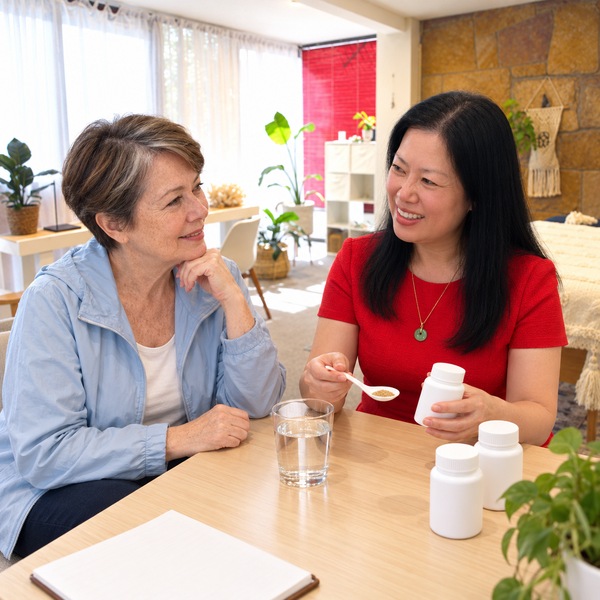
Recognising ginger or liquorice on a label does not tell you how a formula was chosen. Learn which questions to ask about your own bottled granules and why similar-looking products are not swaps.
Glance at the label of a Chinese herbal formula and you might recognise ginger, liquorice or dates from your own pantry. It is tempting to judge the product by looking up each ingredient's reputation, but traditional prescribing does not work quite that way.
In traditional Chinese medicine theory, a formula is considered as a complete combination, chosen in relation to how a particular person presents. The same ingredient may play a different role depending on its companions. Different bottled granule preparations can also vary in composition and directions, even when their names or colours look alike, so a list from a website cannot show you how to rebuild someone else's prescription.

Dr Christine Shen, Acupuncturist, welcomes questions at the Lane Cove clinic about the bottled granules she dispenses:
Avoid swapping in a similar-looking bottle or mixing products based on an online ingredient list, even if a friend's concerns sound like yours. A traditional explanation describes a way of thinking about health; it is not evidence that a formula suits every condition named in a book.
Ask for the product name, directions, storage advice and review date in writing, and keep them beside the bottle. Your GP adjusting a medicine is another reason to tell Christine. If an unexplained symptom appears, check with her before taking more or less.
Some clients who visit mainly for massage or skin-related care still have a herbal product at home from an earlier practitioner. Bring it in with its label intact, and Christine can see exactly what it is and talk through whether it still makes sense for you today.
Copyright© 2002-2026 visuallink© SaaS - Web Hosted Solutions, Design and Maintenance by Visual Link IT Pty Ltd - Software Solutions

Please Login or Sign up to be able to comment